 SMBDashboard
Dog Grooming Prices: Build Your List Backwards
By Mark Fulton · 2026-09-14 · 12 min read
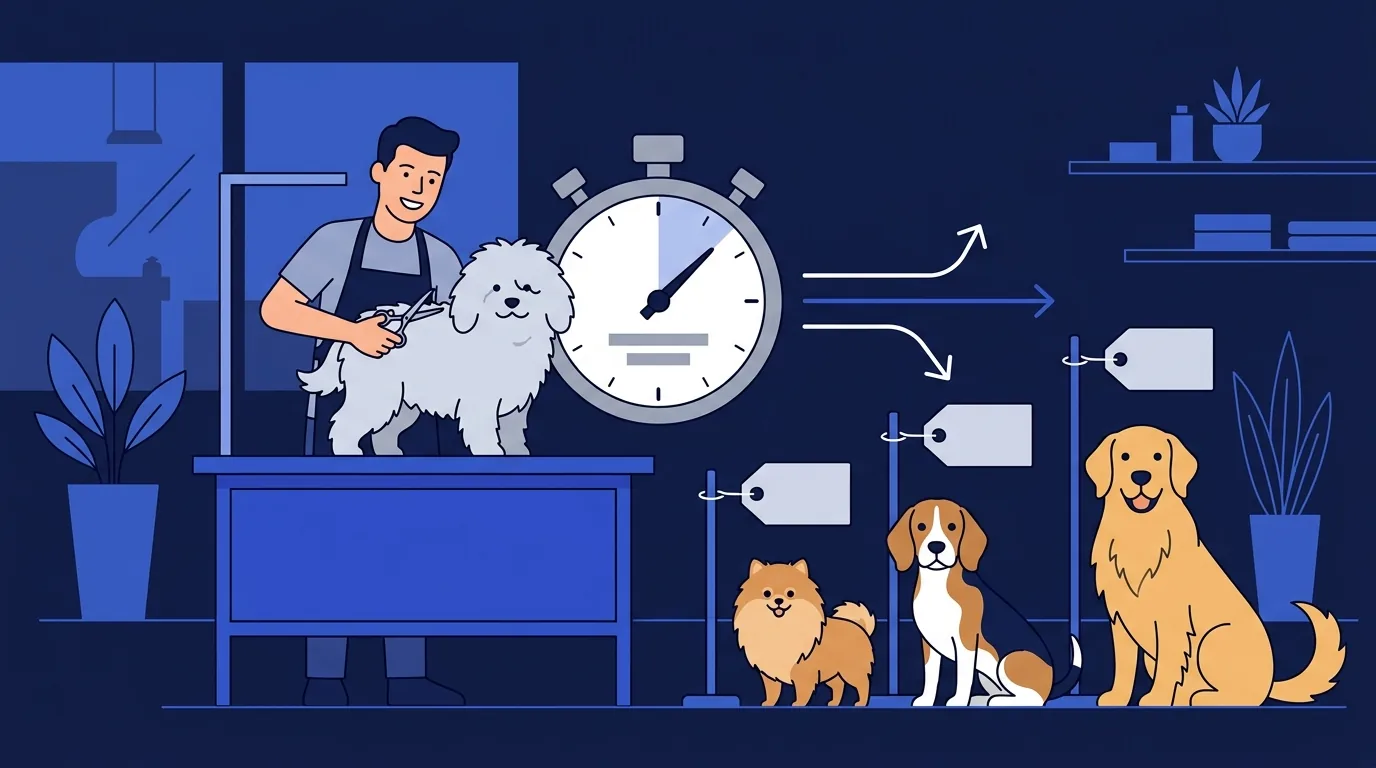
A dog grooming price list works when every line on it earns about the same amount per hour on the table. Groomers price by breed and size, but they get paid by the hour whether the list admits it or not, and the two only line up if you know how long each kind of dog actually takes you. So build the list backwards. Decide the hourly take the business needs, log a month of real groom times by size and coat, multiply each band's typical time by that hourly figure, and round up. Then write the awkward dogs (matted coats, dogs that need extra handling, owners who don't show) into the list as surcharge lines billed in the same unit of time, so the difficult dogs stop being paid for by the easy ones. Local prices still matter, but as a check on the finished list, not as the place to start.
Why does copying local prices go wrong?
Because a local price is the answer to someone else's arithmetic.
When a new groomer wonders what to charge, the easiest numbers to find are what nearby shops post and what consumer price guides say owners pay on average. Those figures describe what customers paid. They say nothing about how long the groomer took, what the rent is, whether the shop runs two tables with a bather or one person out of a van, or whether its "medium dog" is usually a beagle or a doodle.
Copy a list built on different speed and different costs and one of two things happens. If your costs are higher, or your hands are slower on a particular coat, you fill the book and lose money on every one of those dogs. If you are faster, you leave money behind and never find out. Either way, the list stops telling you anything about your own business.
The failure is also quiet. A copied list feels fine for months because the calendar is full, and a full calendar feels like success. Busy is not the same as paid. The only way to see the gap is to put time next to price, and most owners don't do that until the year's numbers come in lower than the diary suggested they should.
There is a place for local prices, and it comes at the end. The U.S. Small Business Administration's guide to planning your business lists pricing among the core market research questions, framed as what potential customers pay for the alternatives. That is a ceiling to understand, not a number to match.
What do you actually need to know before setting a list?
Three numbers, and only one of them comes from outside your shop.
- Your target hourly take. The revenue the business needs for each hour a dog is actually on your table, covering your costs and your own pay. The method is in how to calculate your hourly rate as an owner. The detail that matters for groomers: divide by table hours, not open hours. Phone calls, check-ins, sweeping, and towel laundry all happen during open hours and earn nothing directly, so the table hours have to pay for them.
- Your real time per band. How long each kind of dog takes you from check-in to ready for pickup, measured rather than remembered. Memory keeps the smooth grooms and forgets the ones that ran long.
- What the local market pays. Checked last, to find out whether the list you built is sellable where you work.
It also helps to be clear about structure before any numbers go on paper. Grooming is priced per dog because owners want a figure before they book, but the work itself varies a lot from dog to dog. As covered in how to price your services, a per-job price puts that variance on you. The time bands and surcharge lines below are how a per-dog list hands the predictable part to the price and the unpredictable part to a clearly written rule.
How do you log groom time without slowing down?
Keep it to one line per dog, written at two moments you already stop for.
- At check-in: the time, the size band, the coat type, and the coat condition on arrival (normal, some tangles, matted).
- At ready for pickup: the time.
That's the whole log. No stopwatch per task. Knowing bath, dry, and scissor time separately is interesting, but nobody keeps that up on a packed Saturday, and a log abandoned in week two is worth nothing.
Pick bands you can assign in a glance. A workable starting grid is four sizes (small, medium, large, giant) crossed with three coat types (smooth or short, double coat, curly or drop coat). That is twelve cells, and most shops see about half of them regularly. Adjust the grid to the dogs you actually get.
A few rules make the log trustworthy:
- Time the full job, including cleaning the table afterwards. That time is real and it has to be priced somewhere.
- Record condition on arrival. Without it, matted dogs inflate your "normal" time for their band, and every well-kept dog in that band ends up charged for someone else's long gap between grooms.
- Use the middle value, not the average, once a band has five or more dogs. One three-hour dematting job drags an average up for months. The middle value (the median) ignores it, and the surcharge lines pick up that time instead.
- Give common bands a month and keep logging rare ones. A band with two dogs in it is an anecdote.
The paperwork can be anything. The IRS notes on its recordkeeping page for small businesses that you may choose any recordkeeping system suited to your business that clearly shows income and expenses. That guidance is about tax records, but the principle carries over: a notebook clipped to the grooming table works if you actually fill it in.
How do you turn a target hourly take into per-breed prices?
Here is the full calculation. This is an illustrative example with hypothetical round numbers. It is not real business data and not a suggestion of what anyone should charge.
Take a solo groomer with $3,000 a month of costs (rent, insurance, supplies, equipment wear) and a target of $4,000 a month in owner pay. That is $7,000 of revenue needed. Say the book allows 100 table hours a month.
$7,000 needed ÷ 100 table hours = $70 per table hour
A month of logs then gives these middle times for dogs arriving in normal condition:
| Band | Median logged time | Time × $70 per hour | Listed price (rounded up to the next $5) |
|---|---|---|---|
| Small, smooth coat, bath and tidy | 45 min | 0.75 × $70 = $52.50 | $55 |
| Small, drop coat, full groom | 90 min | 1.5 × $70 = $105 | $105 |
| Medium, curly coat, full groom | 105 min | 1.75 × $70 = $122.50 | $125 |
| Large, double coat, bath and deshed | 120 min | 2 × $70 = $140 | $140 |
| Large, curly coat, full groom | 180 min | 3 × $70 = $210 | $210 |
Two things jump out. The two small dogs weigh the same, yet one costs nearly twice as much to groom as the other, and a list priced by weight alone charges them the same. And the most expensive line is the large curly coat, which is the one most easily underpriced, because the number looks large on paper even when the hours behind it are larger.
Now run the same shop with a copied list that has a single "large dog full groom" price of $140:
Large double coat:  $140 ÷ 2 hours = $70.00 per hour
Large curly coat:   $140 ÷ 3 hours = $46.67 per hour
Shortfall per curly-coat hour: $70.00 minus $46.67 = $23.33
Four curly-coat dogs a week = 12 hours × $23.33 = $280 a week
Over four weeks = $1,120
In this example, that one line quietly gives away $1,120 a month, and the calendar looks exactly as full as it would with the right price.
Rounding up on every line is a small cushion for the minutes the log didn't catch. Listing each price as the price for a dog arriving in normal condition, with the surcharges printed underneath, keeps "starting at" honest.
Only now does the market check happen. Put the finished list next to what shops near you charge. If one of your bands sits well above them, you have three options: get faster on that coat, change what the service includes, or accept that you will groom fewer of those dogs. If a band sits well below, you have found room that copying would never have shown you. Where you land is your decision.
How should matting and behaviour surcharges work?
In the same currency as the rest of the list: time, at the same hourly take. And written down before the dog arrives, not invented at the counter.
Continuing the same illustrative $70 per hour example:
| Surcharge line | How it is billed | Example arithmetic |
|---|---|---|
| Dematting | Per 15 minutes beyond the band's median time | 0.25 × $70 = $17.50, listed as $20 per block |
| Extra handling (breaks, slow work, a dog that needs settling) | Per 15 minutes beyond the band's median time | $20 per block |
| A second pair of hands | Your helper's cost for the minutes they spend at the table, on top of the blocks | Depends on what that person costs you |
| Missed appointment without notice | A set share of the booked band's price, stated when the booking is made | 50% of $125 = $62.50 |
Why blocks rather than a flat "matting fee"? A flat fee overcharges the dog with a few tangles behind the ears and badly undercharges the dog that arrives felted from neck to tail, and both owners feel it is arbitrary. Blocks tie the charge to the clock you are already reading, so the conversation is about minutes, not opinions.
The surcharge lines also make the owner conversation easier. The ASPCA's dog grooming tips point out that long-haired dogs prone to matting benefit from a daily brushing routine, and that dense matting may call for clipping with care near the skin. A matted coat is usually a home-care and interval problem, and a surcharge line printed on the list tells the owner, without a lecture, what the gap between visits costs.
Handle it the same way every time:
- Note the coat condition at check-in and tell the owner the likely number of extra blocks before you start.
- If the groom runs past that estimate, text before continuing.
- If a dog is too stressed to finish safely, stopping and billing the time used is a written policy, not a failure or a favour.
Without these lines, the extra 45 minutes on a matted dog comes out of the hourly take for the whole week. The only way to recover it is to raise every price, which charges the owners who brush their dogs for the owners who don't.
When and how do you revise the list?
On a schedule, from the log, one line at a time.
- Keep the log running. Every quarter, recompute the median time for each band. If a band's middle time has drifted up by 15 minutes, that line gets a new price and nothing else has to move.
- Recompute the hourly take when costs change, such as a rent renewal, an insurance renewal, or a jump in supply prices.
- Split bands that don't hold together. If one band keeps producing times far on either side of its median, it is really two kinds of dog wearing one label.
- Read the book as a signal. A band that books out weeks ahead while another leaves gaps is telling you something about price, demand, or both.
One boundary, stated plainly. Everything above is the mechanics of building a list from your own numbers. It is not financial, tax, or legal advice, and it does not tell you what to charge. For the cost and tax side of the hourly take, a bookkeeper or accountant who can see your actual figures is the right second opinion.
FAQ
How do groomers decide prices by breed?
Most lists group dogs by size and coat type rather than naming every breed, because a breed is really a shorthand for how long the dog takes. A breed-by-breed list can work well, as long as each price comes from logged times and the breed name is simply a label on a time band. For mixed breeds, band the dog by the coat it actually has on the table, not by the name on the booking.
Should I charge extra for matted coats?
The time case for it is simple: a matted coat takes longer and needs more careful handling, and that time has to be paid for by someone. If you do charge, bill it in blocks of time beyond the band's normal time rather than a flat fee, mention it when the booking is made, confirm the likely amount at check-in, and text before going past the estimate. Whether to charge and at what rate is your call.
How do I raise grooming prices with regulars?
Tell them before the appointment, never at the counter. Give a clear date the new price starts, give the reason in one sentence (your times or your costs moved), and change only the lines that actually moved rather than the whole list. Many groomers keep the old price for appointments already in the book and apply the new one from the next booking, which makes the change feel planned rather than sprung on anyone.
What's a realistic number of dogs per day?
It is arithmetic, not a benchmark. Divide the table hours in your day by the median time for your usual mix of dogs. As a hypothetical example, six table hours with a mix averaging 90 minutes is four dogs, and swapping one of those for a three-hour curly coat costs you roughly one small dog. The other limit is physical, and the log shows it too: if your times creep up on the last dog of the day, your realistic number is lower than the arithmetic says.
Sources
- U.S. Small Business Administration, Plan your business, on pricing as a core market research question
- Internal Revenue Service, Recordkeeping for small businesses, on choosing any system that clearly shows income and expenses
- ASPCA, Dog grooming tips, on brushing routines for coats prone to matting
Put a month of real times behind your list
The whole method rests on one month of honest times. Log each groom in the appointments module of SMBDashboard once the dog is ready for pickup: the band as the title (for example "Medium, curly coat, full groom"), the duration set to the minutes it actually took, and the coat condition and any extra blocks in the note. At the end of the month, read back each band's grooms, take the middle time, and multiply by your hourly take. A month of real times sets the list, and it is a far better argument than anyone else's price board. It's free, there's no account to create, and your data stays in your browser unless you turn on Pro sync. The free tier holds 25 customers, 200 money entries, and unlimited tasks. Pro removes the caps and adds CSV export, recurring entries, and your own branding on the printed report, at $48 every six months (about $8 a month) or $149 once.