 SMBDashboard
How to Track Unpaid Invoices Without Software
By Mark Fulton · 2026-08-31 · 14 min read
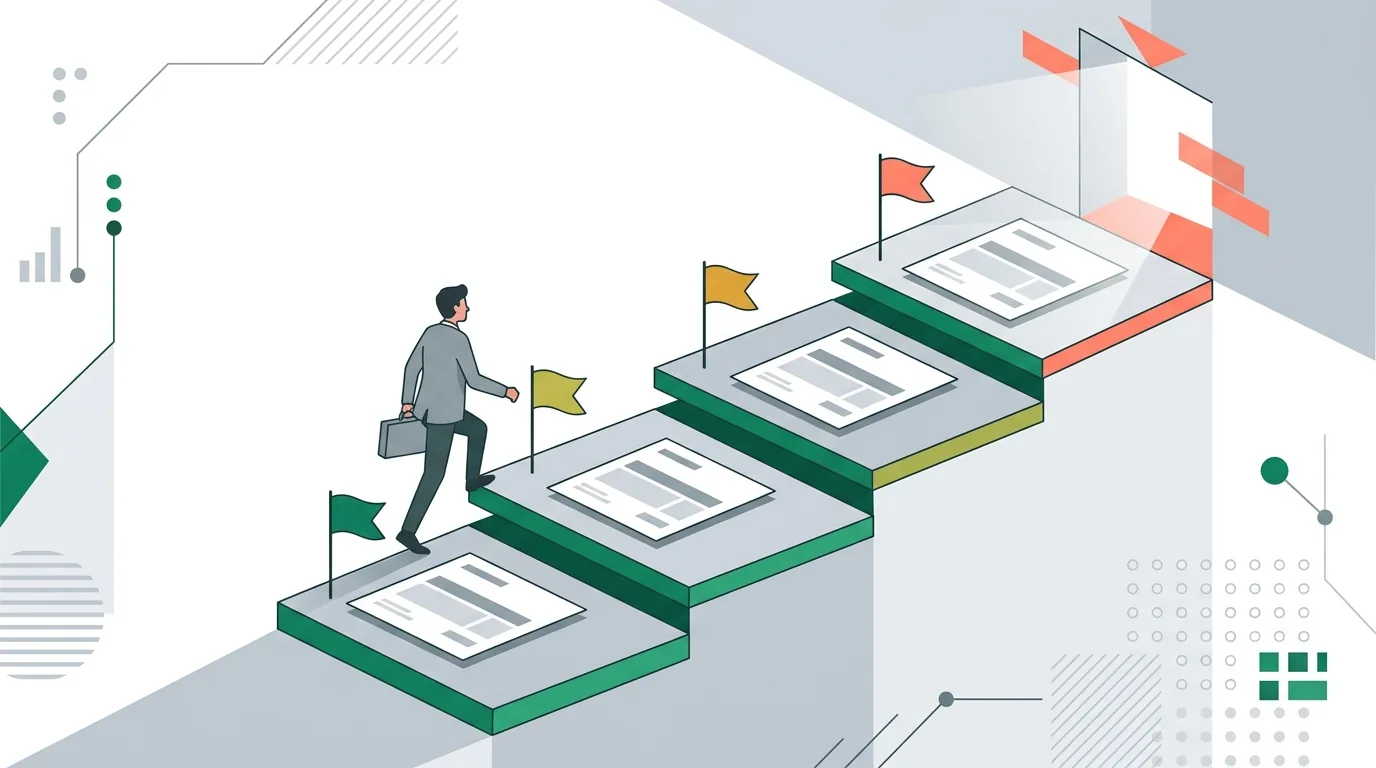
You do not need an accounts receivable system to know who owes you money. You need one line per invoice with a paid or unpaid flag on it, and a fixed schedule for what you send on day 7, day 14 and day 30. That is the whole mechanism. The record can live in a notebook, a spreadsheet, or a browser tab, and it will work as long as the unpaid ones are visible somewhere you actually look every week. The part that decides whether you get paid is not the tool. It is having decided, before you needed it, exactly what you send and when.
Most guidance on this question answers a different question. It answers "what invoicing platform should I buy", which is a reasonable thing to want if you send two hundred invoices a month, and an odd thing to be told if you send nine. If you send nine, the software will not tell you anything you do not already half know. What you are missing is not a dashboard. It is the wording of a follow-up you have been putting off for eleven days.
Why do unpaid invoices disappear from view?
An unpaid invoice is a strange kind of record. The moment you send it, it stops being work and starts being waiting, and waiting has no home in most people's systems. The job is finished. The file is closed. The invoice moves from your to-do list into your sent folder, which is the one folder nobody reviews.
Three things then happen in order.
First, you record the sale as revenue in your head. The number went into your mental total for the month on the day you sent it, so the money already feels like it arrived. Second, the due date passes on a day when something else was on fire, and the absence of a payment produces no signal at all. Nothing beeps when money does not turn up. Third, at around three weeks, chasing it starts to feel awkward, because now you are asking about something old, and the awkwardness makes you postpone it another week, which makes it more awkward.
This is why the cash gap is so common and so quietly damaging. When the Federal Reserve Banks asked small employers about their financing in the 2026 Report on Employer Firms from the Small Business Credit Survey, 60 percent of firms had applied for financing in the previous twelve months, and the most common reason, at 56 percent, was to meet operating expenses. That survey was fielded from September to November 2025 and drew 6,525 responses from firms with 1 to 499 employees, and the researchers are clear that it is a convenience sample rather than a random one. Read it as a strong signal rather than a precise population figure. The signal is that a great deal of small business borrowing is bridging a gap between work done and money received, and some part of that gap is invoices nobody is chasing.
You do not fix that with better software. You fix it by making the unpaid ones impossible to not see, and by removing the decision about what to do next.
What is the minimum record that keeps them visible?
Six fields. That is the entire record, and every field earns its place because you will use it in the chase.
- Date sent. Not the date of the work. The date the invoice went out, because every deadline counts from there.
- Customer. A name you will recognise in three weeks.
- Amount.
- Due date. Whatever your terms say, written as an actual date so you never have to do arithmetic while deciding whether to send something.
- Status. Open or paid. One flag, two states.
- Last contact. The date of the most recent thing you sent about it. This is the field everyone leaves out and the one that makes the chase schedule work, because it turns "have I already nudged them?" from a memory problem into a lookup.
Notice what is not there. No aging bucket, no days sales outstanding, no collection probability score, no invoice number if you do not already use them. Enterprise finance teams need those because they are managing thousands of invoices across several people. You are managing eleven across one person, which is you. The same principle applies here as everywhere else in a small operation: the number you will actually keep current beats the more sophisticated number you will abandon in March. That is the same reason a simple CRM is enough for most small businesses.
The status flag is the load-bearing part. Everything else is context. If the only thing you do after reading this is add an open or paid column to whatever you already keep, and filter to open once a week, you have solved most of the problem.
In SMBDashboard the money module does this without an invoicing feature at all. You log the income entry when you send the invoice and leave its status chip on open. The entry sits in your money list with a customer attached and an open badge. When the payment lands you click the chip once and it flips to paid. There is a filter row above the entries with an open invoices option that shows you only the unpaid income, and the overview screen carries an Open invoices tile with the total dollars outstanding and a count underneath it, so the number is on the first screen you see rather than buried. The money item in the sidebar also carries a badge with the count when it is above zero. That filtered list is your chase list. Open it, work down it, close the tab. Your data stays in your browser unless you turn on Pro sync, so this is a private list on your own machine rather than an account somewhere.
You can open the money module free and set this up in about five minutes with your last month of invoices. The free tier holds 200 money entries and 25 customers, which is a year or more of records for most solo operations. Pro removes those caps and adds CSV export and recurring entries, where a duplicated income entry arrives marked unpaid so the open figure stays honest.
What should the first reminder say?
The first reminder is not a chase. It is a confirmation, and the tone difference matters more than the timing.
Most invoices that go unpaid at day 7 are not being refused. They are sitting in an inbox behind forty other emails, or they went to the person who hired you rather than the person who pays, or the accounts run on a Thursday and yours arrived on a Friday. Your first message should assume all of that, because it is usually true, and because a polite assumption costs you nothing and a suspicious one costs you the relationship.
Keep it short enough to read on a phone. Restate the amount and the date so nobody has to open an attachment to know what you are talking about. Ask one question. Do not apologise for asking, and do not pad it with three sentences about how you hate to bring this up, because that signals that you think you are doing something rude, and you are not. You are asking to be paid for work you did.
Here is wording you can copy for day 7:
Hi [name], just checking this one reached the right person. Invoice for [amount], sent [date], due [due date]. If it needs to go to someone else in accounts, tell me who and I will resend it there. Thanks.
That is it. Forty words. It gives them an easy, face-saving reason to reply, which is what you want, because a reply of any kind tells you which of the three problems you have.
How long before you escalate?
Escalation is a schedule, not a mood. Decide it once, apply it to everyone, and you never have to spend energy deciding whether this particular customer has earned a nudge yet.
| Day | What happens | Who sends it | What it says |
|---|---|---|---|
| Day 0 | Invoice goes out, logged as open, due date written down | You | The invoice, the amount, the due date, and how to pay |
| Day 7 | Soft check that it reached the right person | You, same channel as the invoice | Restates amount and date, asks if it needs redirecting |
| Day 14 | Direct request for a payment date | You, and add a phone call if you have the number | Asks when it will be paid, not whether |
| Day 30 | Decision point. Stop chasing on repeat and change something | You | Either a final plain notice, or a conversation about terms |
Day 0 is doing more work than it looks. If the invoice does not go out the same day the work finishes, everything downstream slides, and the most common reason an invoice is unpaid at day 40 is that it was sent on day 12.
Day 14 is where the tone changes, once. You are no longer asking whether it arrived. You are asking for a date. The question "when will this be paid" is much harder to leave unanswered than "did you get this", because a non-answer to a date question is itself an answer, and both of you know it.
Wording you can copy for day 14:
Hi [name], following up on invoice for [amount] from [date], which is now [number] days past due. Can you give me a date when it will be paid? If there is a problem with the invoice or the work, tell me and I will sort it out today.
The second sentence is not softness. It is diagnosis. If there is a dispute, you want to find it on day 14 rather than day 60, because a dispute you know about is a problem you can fix and a dispute you do not know about is silence you will misread as rudeness.
If you have a phone number, day 14 is when you use it. A two minute call resolves more of these than four emails, partly because it is harder to defer and mostly because it is faster for them too. Log the call in your last contact field either way.
The whole ladder only works if something puts it in front of you. That is a weekly job, not a daily one. Add "who is past due" to whatever you already look at on Monday, alongside the numbers worth checking every Monday, and it takes about ninety seconds. The printable weekly report includes the open invoices total for the same reason, so the figure is on the page you already print rather than in a system you have to remember to open.
When do you change the terms instead of chasing?
Day 30 is a decision, and the decision is usually not "chase harder".
Chasing has a shape. The first two messages recover most of what is recoverable. After that, sending a fourth and fifth version of the same request mostly teaches the customer that your deadlines are decorative, and it costs you a surprising amount of attention for a small chance of a different result. So at day 30, pick one of three roads.
Change the terms for the next job. This is the most useful and least used option. If someone reliably pays at day 45, you do not have a chasing problem, you have a terms problem, and it is solvable at the point of sale rather than the point of collection. Deposit up front. Payment on delivery rather than net 30. Staged payments on longer work. Card on file. You are not punishing them. You are pricing in a fact about how they pay.
Have one direct conversation. Not another email. A call or a meeting where you ask what is actually going on, and where a payment plan is on the table if the honest answer is that money is tight. Half of a business's genuinely difficult receivables are customers in trouble who are avoiding you out of embarrassment, and a plan they can meet is worth more than a demand they cannot.
Hand it to a professional, and stop doing it yourself. There is a real boundary here and it is worth naming plainly. Everything above is administration: keeping a record, sending polite reminders, asking for a date. Formal demand letters, late fee entitlements, interest, small claims filings, sending an account to a collection agency, and writing a debt off are not administration. They are governed by law that varies by country and by state, they carry rules about what you may say and how often you may say it, and this article is not the place to learn them. The Consumer Financial Protection Bureau's debt collection material will give you a sense of how regulated that territory is, and it deals with consumer debt specifically, which may or may not be what you are holding. Once you are past a polite request for a date, take it to an accountant, a bookkeeper, or a lawyer who knows your jurisdiction.
The tax side sits in the same category. If you eventually treat an unpaid invoice as a loss, how that works depends on which accounting method you use. The IRS guidance on the bad debt deduction in Topic 453 explains that a business bad debt is deductible in the year it becomes worthless and that you have to show you made reasonable efforts to collect, and it also notes that cash method taxpayers generally cannot deduct unpaid fees and similar items, because that income was never counted as income in the first place. Which of those applies to you is a question for whoever does your return. Keeping a dated record of every reminder you sent is useful regardless, and it is another argument for that last contact field.
How do you spot the pattern of a habitually late payer?
One late invoice is an accident. Three from the same customer is a policy, and it is their policy, not yours.
You will only see it if you keep the history. This is the quiet payoff of logging invoices as entries against a customer rather than filing them as documents: after six months you can look at one customer and see not just what they owe now but how they have paid every time. Look for three things.
The gap between due date and payment date, repeated. If it is consistently 18 days, that is their internal cycle and no reminder will change it. Build it into your terms and your cash planning and stop being annoyed by it.
Which reminder triggers payment. Some customers pay on day 7 every time. Some never move until the day 14 message. If you know which, you have effectively learned their real due date.
Whether the amount predicts the delay. Larger invoices often need a second approver, which is a structural delay rather than a reluctance. Splitting the same work into two smaller invoices sometimes clears it without a single awkward conversation.
None of this needs a report. It needs the notes to exist, which is the same reason a follow-up you did not write down did not happen. The habit is the same one described in stop losing track of customer follow-ups, applied to money rather than conversations, and it belongs in the same weekly pass as your one page weekly review.
Where this ends up: mark the entry open when you send the invoice, filter to open once a week, and let the day 7 and day 14 wording do the work you would otherwise spend a Sunday evening dreading. The open invoices view in the money module is free and takes a few minutes to fill in. The tracking part of this problem is genuinely small. It is the deciding that people pay software to avoid, and the schedule above does that for nothing.
Frequently asked questions
How long should I wait before chasing an invoice?
Seven days past the send date for a light check that it reached the right person, and seven days after that for a direct request for a payment date. Waiting until the due date passes to make first contact means the first message you ever send about the invoice is already a chase, which is a worse conversation for both of you. Some owners prefer to send the day 7 note before the due date rather than after, framed purely as confirmation, and that works well for net 30 terms.
Should I charge late fees?
That is not a question this article can answer for you, and be careful with any page that gives you a percentage. What you may charge, whether it has to be in the contract beforehand, and how interest on overdue commercial debt is treated all depend on where you and your customer are. Ask an accountant or a lawyer in your jurisdiction before you put a late fee clause in your terms. What is worth saying generally is that late fees rarely change the behaviour of a genuinely slow payer, while changing the payment terms for the next job usually does.
What do I do if a customer won't pay?
Distinguish between cannot and will not, because they need opposite responses. Cannot usually means a business in trouble, and a payment plan you both agree to recovers more than escalation does. Will not usually means a dispute nobody has said out loud, so ask directly what the problem with the work or the invoice is. If neither of those is the answer and the amount matters, stop chasing it yourself and take it to a professional. Formal demands, collection agencies and small claims are all real options and all of them are legal territory rather than admin.
How do I keep track of who owes me money?
The minimum is a list with a status flag you can filter, reviewed weekly. A spreadsheet with six columns is genuinely enough, and so is a notebook if you look at it. If you would rather not maintain the spreadsheet, log income as it is invoiced in the money module, leave the status on open until the payment lands, and use the open invoices filter as your chase list. The same open total prints on the weekly business report. Your data stays in your browser unless you turn on Pro sync, and the free tier covers 200 money entries and 25 customers before any of that becomes a decision. If your invoicing genuinely runs to hundreds a month across several staff, that is the point where dedicated invoicing software starts earning its subscription, and you should buy it.