 SMBDashboard
Photography Business Numbers Worth Tracking
By Mark Fulton · 2026-09-10 · 13 min read
Last verified
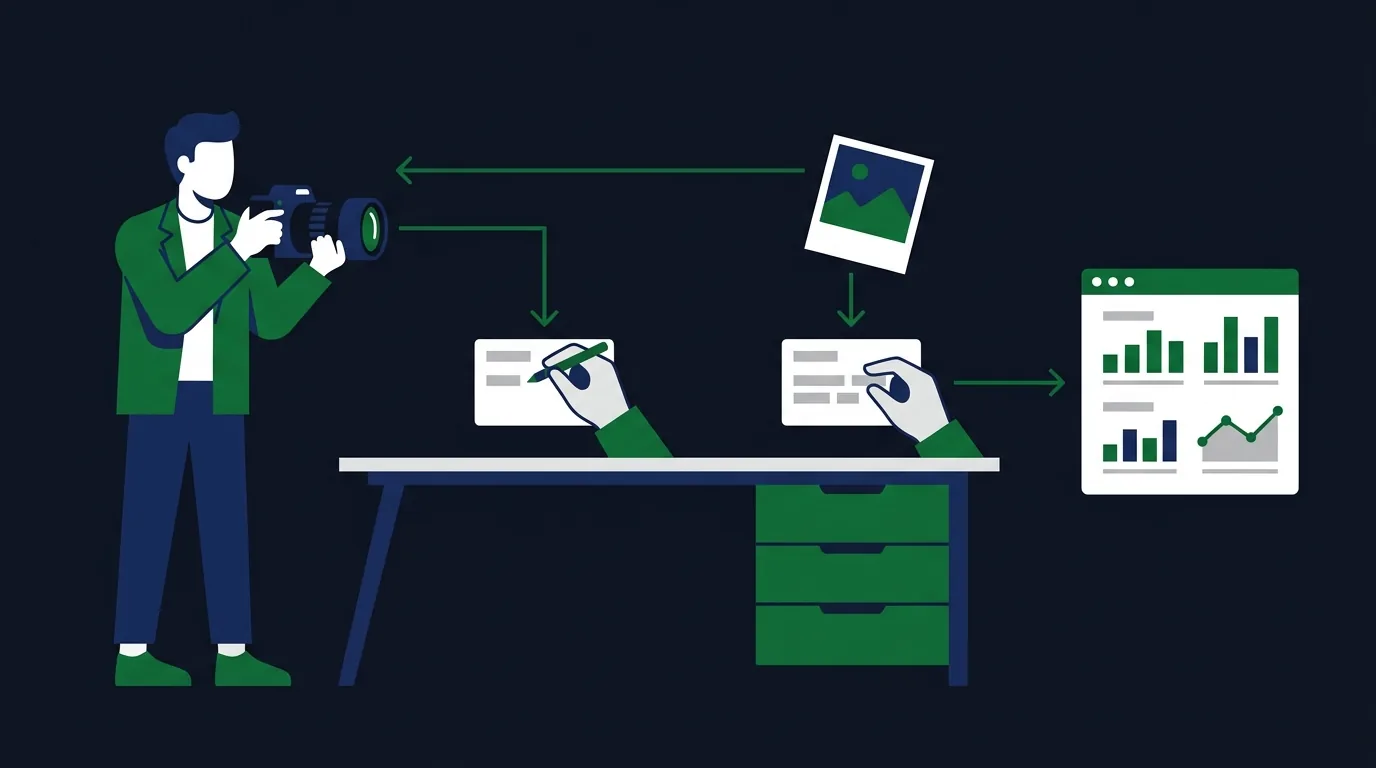
Photography has a timing problem that most trades do not. The enquiry, the booking, the shoot and the final payment can sit months apart, so by the time the money lands, nobody remembers what it was for.
Four numbers change decisions in a photography business: the share of enquiries that turn into bookings, the average value of a booking once add-ons are counted, the total hours a shoot costs you once culling and editing are in, and the shape of your year. None of the four can be reconstructed in January from a bank statement, because the bank statement does not know when the enquiry arrived, how many hours the edit took, or which package the money was for. All four fall out of one small record kept per shoot: nine fields, five filled the day you book and four filled the day you deliver.
Every figure in the worked examples below is invented to show the arithmetic. None of it is an average, a benchmark, or a number you should expect to match. And none of this is tax or accounting advice. It is arithmetic you can run on your own records. Anything touching a deduction, a filing or how a cost should be classified on a return is a conversation with a bookkeeper or an accountant.
Which photography numbers are actually decision-changing?
Most metric lists written for photographers are marketing lists: website sessions, Instagram engagement, email open rates, Pinterest saves. Those are real measurements, but they sit upstream of the thing you are trying to fix, and they only become useful once you already know your downstream numbers. If your enquiries convert at a healthy rate, more traffic is the right project. If they do not, more traffic just gets you more people to disappoint.
A number earns its place when seeing it on its own would change something you do. On that test, four survive:
- Enquiry-to-booking rate. Tells you whether your problem is demand or conversion. Those two problems have completely different fixes and are constantly mistaken for each other.
- Average booking value. Tells you whether to change your prices or change what you offer alongside them. Your advertised package price is not this number.
- Hours per shoot, all in. Turns revenue into a rate. Without it, a busy year and a good year are indistinguishable until you are exhausted.
- Seasonality. Tells you when to market, when to hire a second shooter, and when you can take two weeks off without it costing anything.
A fifth, profit by package, is not a separate measurement. It is what you get when you group the second and third by the thing you sold.
The IRS lists monitoring the progress of your business first among the reasons to keep records at all in Publication 583 on starting a business and keeping records, ahead of anything to do with filing. That ordering is not an accident. Records built only to survive tax season answer tax questions and nothing else.
How do you calculate enquiry-to-booking rate?
The formula is simple. Getting the two counts to line up is the part people get wrong.
Enquiry-to-booking rate = bookings taken / enquiries received, for the same group of enquiries
Two traps sit in that sentence.
The first is the period. It is tempting to count this month's bookings against this month's enquiries, but a March enquiry for an October wedding books in May. Comparing the two counts inside one calendar month measures nothing. Count by enquiry cohort instead: of the enquiries that arrived in March, how many eventually booked? You have to wait for the cohort to close, which for portrait work might be three weeks and for weddings might be three months. That wait is the price of a number that means something.
The second is what belongs in the denominator. Some enquiries were never winnable by you: the date was already taken, the request was for a genre you do not shoot, or you turned it down on purpose. Keeping those in the denominator makes your selling look worse than it is. Keeping them out entirely hides a real signal about the enquiries you attract.
So record an outcome on every enquiry, one of five: booked, lost on price, lost on date, no reply, declined by me. Then you can read two rates from the same tally.
Here is the arithmetic on illustrative figures. Say 12 enquiries arrive in March. One is for a genre you do not shoot, so you decline it. Of the remaining 11, five book.
- Demand basis: 5 ÷ 12 = 41.7%. This is the rate that reflects everything your marketing brought in.
- Conversion basis: 5 ÷ 11 = 45.5%. This is the rate that reflects how you handle an enquiry you actually wanted.
If those two numbers diverge a lot, your marketing is attracting the wrong people, and that is a different project from improving your reply email.
What is average booking value once add-ons are counted?
Average booking value is the total you invoiced across completed bookings divided by the number of bookings. Not the package price on your website, and not the base fee on the contract.
Average booking value = total invoiced across completed bookings / number of completed bookings
Run it twice, once on the quoted base and once on the final invoiced total, and the gap between them is your add-on lift. Illustrative year: 34 completed bookings, quoted bases totalling $17,000, final invoiced totals of $21,760.
- Base average: $17,000 ÷ 34 = $500
- Final average: $21,760 ÷ 34 = $640
- Add-on lift: $640 − $500 = $140 per booking, which is 28% above base
That 28% is one of the most actionable figures in the business, because it responds to things entirely inside your control: whether you offer prints at delivery, whether the gallery has an obvious upgrade path, whether you mention the album before the shoot rather than after. Moving it from 28% to 35% on those same 34 bookings adds $1,190 with no extra shoots and no price rise.
One caution on averages. If your book contains a handful of weddings and a long tail of small sessions, the mean is dragged around by the big jobs. Look at the median alongside it, which is just the middle value when you sort the list. If the mean is much higher than the median, your income depends on a few large bookings, and you should know that before you plan a year around it.
How many hours does a shoot really take?
This is where photography numbers go wrong most often, because the visible part of the job is the smallest part. Two columns fix it: shoot hours (travel and time on location) and editing and admin hours (culling, editing, gallery build, delivery, the emails either side).
Then subtract the money that only exists because this shoot happened. Direct costs for a shoot are things like a second shooter, print or album fulfilment, permits and parking, card processing fees, and the miles you drove. On mileage, the IRS publishes a standard mileage rate each year for business use of a car, set at 76 cents a mile for the second half of 2026, up from 72.5 cents for the first half. Its purpose is tax, and how you use it on a return is a question for your accountant, but as a published figure for what running a mile in your own car costs, it is a reasonable stand-in for this calculation.
Effective hourly rate = (final invoiced total − direct costs) / (shoot hours + editing and admin hours)
Worked through on an illustrative family session:
- Final invoiced total: $630 (a $450 base plus a $180 print credit taken at delivery)
- Shoot hours: 1.5 on location, 1.0 driving, so 2.5
- Editing and admin hours: 1.0 culling, 2.5 editing, 0.5 gallery and email, so 4.0
- Direct costs: 40 miles at 76 cents = $30.40, print fulfilment $95.00, card fee at 2.9% plus 30 cents on $630 = $18.57. Total $143.97
So: ($630 − $143.97) ÷ (2.5 + 4.0) = $486.03 ÷ 6.5 = $74.77 an hour.
Now look at the number the same shoot appears to earn if you count only the camera time: $630 ÷ 1.5 = $420 an hour. That gap, $420 down to $74.77, is the entire reason busy photographers feel poor. Nothing has been done wrong. One figure is answering a much narrower question than the owner thinks it is. The same move, pricing your own hours in as a real cost, is what makes a handmade shop's numbers honest too, and it works the same way when you take an Etsy order apart end to end.
Once you have a few dozen of these, you have your real denominator, and you can run the rate calculation in reverse to see what you would need to charge for a target income. That reverse version is laid out in full in how to calculate your hourly rate as an owner.
How do you see your seasonality?
Seasonality is two counts per month, not one: enquiries received and shoots delivered. Everyone tracks the second. The first is where the decision lives.
Because of lead time, the enquiry peak arrives before the shoot peak, and the gap between them is your planning window. If enquiries for autumn portraits crest in early August and the shoots land through October, then anything you do to fill October has to happen in July. Marketing in September is marketing at a month that is already decided.
Lead time is easy to measure once you record two dates per booking. Subtract the enquiry date from the booking date to get how long people take to decide, and the shoot date from the booking date to get how far ahead they commit. A year of those two numbers tells you when to open dates, when to run a mini-session day, and when to stop refreshing your inbox because nobody in your genre books in that month.
The third seasonal line worth keeping separate is cash. A retainer at booking and a balance at delivery mean the month you earn revenue and the month you get paid are different months, sometimes by a season. A booked October is not a paid October.
What should you record per shoot?
Nine fields. Five when you book, four when you deliver. That is the whole system, and it is deliberately small, because a record you fill in twice per job survives and a record you fill in continuously does not.
| Field | Filled when | The annual number it feeds |
|---|---|---|
| Enquiry date | At booking | Lead time, seasonality of demand, enquiry cohorts |
| Booking date | At booking | Decision time, monthly bookings taken, cash timing |
| Shoot date | At booking | Seasonality of delivery, calendar load, capacity |
| Package and quoted base | At booking | Revenue by package, base average |
| How they found you | At booking | Source mix, which channel earns your marketing time |
| Final invoiced total | At delivery | Average booking value, add-on lift |
| Shoot hours (travel plus location) | At delivery | Hours per shoot, effective hourly rate |
| Editing and admin hours | At delivery | Hours per shoot, and the half everyone omits |
| Direct costs for this shoot | At delivery | Contribution per shoot, profit by package |
The record does not produce your enquiry-to-booking rate on its own, and no per-shoot record can, because the enquiries that never became shoots are not in it. That denominator needs one line per enquiry: date, name, what they asked for, outcome. Four fields, ten seconds, kept in the same place as everything else.
The fields that feel useful and quietly kill the habit are worth naming too. Keeper rate, gear used per shoot, weather, edit-pass counts, client mood, hours split by editing software: every one of them turns a twenty-second entry into a form, and a form is what you stop filling in around week six. If a field cannot be tied to a decision you would actually make, leave it out. You can add a tenth field later, when a question keeps coming up that the nine cannot answer.
Where the record lives
You can keep all of this in a notebook, and plenty of photographers do. The only requirement is that the booking half and the delivery half end up attached to the same job.
In SMBDashboard the split falls out naturally. A shoot goes in as an appointment with its date, time, duration and a note, linked to the customer. The invoiced total goes in the money module as an income entry against that same customer, marked paid or unpaid so open balances stay visible. Direct costs go in as expenses against the same customer, so the per-job total reads back without any grouping work. The enquiry date, the source and the outcome sit in the customer record as notes and tags, which is also where the enquiries that never booked belong. Track shoots as appointments and payments as money entries, and the yearly picture assembles itself instead of being rebuilt in January.
It is free and there is no account. Your data stays in your browser unless you turn on Pro sync, which is off by default. The free tier holds 25 customers and 200 money entries, which is roughly a year of a portrait business once costs are logged alongside income; Pro removes both caps and adds CSV export, recurring entries and your own branding on the printed weekly report. If you want the shorter weekly version of all this, the numbers to look at every Monday covers what to check while the year is still in progress.
Frequently asked questions
What is a good booking rate for a photographer?
There is no trustworthy published benchmark, and you should be wary of the figures that circulate. Every number you will find quoted comes from one coach's own book or a small unpublished sample, and booking rates move enormously with genre, price point, lead source and how many other photographers the client contacted at the same time. A wedding photographer taking cold enquiries from a directory and a newborn photographer working almost entirely on referral are not measuring the same thing.
Read your own rate against your own history instead. Three months of honest counting gives you a baseline, and after that the level matters far less than the direction. When it moves, ask which of three things changed: the quality of enquiries coming in, how fast and how well you answer them, or your price. Note also that a very high rate is not automatically good news. If almost everyone who asks says yes, you may be the cheap option, and the fix is a price test rather than a celebration. A modest rate can be perfectly healthy if the bookings you win are the ones you wanted.
How do I work out my hourly rate including editing?
Take the final invoiced total for a shoot, subtract the costs that exist only because of that shoot, then divide by every hour the job consumed: travel, time on location, culling, editing, gallery delivery and the emails on both sides. In the illustration above that produced $486.03 across 6.5 hours, or $74.77 an hour, against an apparent $420 an hour if you counted only the time the camera was out. Do it for ten shoots and average the results. That average is the number to use when you are deciding what to charge or whether a package is worth offering.
Should I track enquiries I turn down?
Yes, and separately from the rest. An enquiry you declined tells you something the ones you chased cannot: which requests your marketing is pulling in that you do not want. If a third of your enquiries are for a genre you stopped shooting two years ago, that is a website problem with a specific fix. Record the outcome on every enquiry with a reason, then calculate both a demand-basis rate that includes everything and a conversion-basis rate that excludes the ones you turned away. Watching the two move apart is more informative than either on its own.
How do I know which package is most profitable?
Group your completed shoots by package, then compare contribution per hour rather than headline price. Contribution is the invoiced total minus that shoot's direct costs, and the hours are all of them, editing included. On illustrative figures: a $630 session with $143.97 of costs across 6.5 hours returns $74.77 an hour, while a $1,200 package with $340 of costs across 14 hours returns $860 ÷ 14 = $61.43 an hour. The bigger package brings in nearly twice the money and pays you less for your time. You may still want to sell it, for the portfolio or the referrals it generates, but you should be choosing that with the number in front of you rather than assuming the larger invoice is the better job.
Most business establishments in the United States have no paid employees at all, which is why the U.S. Census Bureau counts them separately in its nonemployer statistics program. If your studio is one of them, this matters more rather than less: when the business is one person, an hour spent on the wrong package is an hour that does not come back.