 SMBDashboard
Cash Flow Basics for Small Business Owners
By Mark Fulton · 2026-08-24 · 12 min read
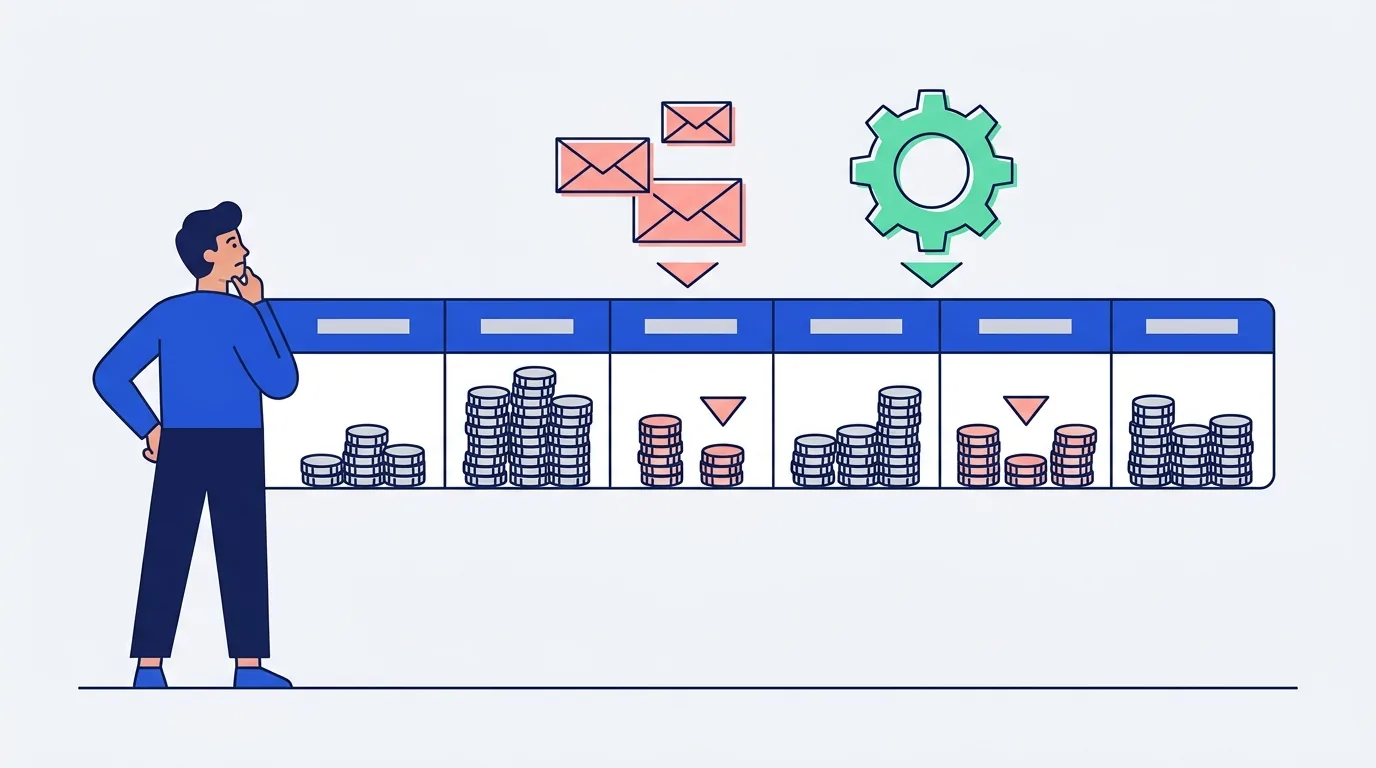
Cash flow is the money that actually moves into and out of your bank account, dated by the day it moves. Profit is what you earned minus what you spent, dated by the day the work happened. Those two calendars are different, and the gap between them is why a good month can still leave you short on the 15th. The practical version of cash flow management for a small business is not a financial model. It is a 13-week list of dated money in and dated money out, built from three things you already have: invoices you have sent but not been paid for, costs that repeat on a schedule, and jobs already on the calendar.
Most cash flow explanations start with a definition and end with a recommendation to arrange a credit line before you need one. That advice is not wrong, but it answers a question you were not asking. The question in your head is narrower and more urgent: will there be money in the account on the 15th, and if not, what do I do this week about it?
This is the pillar page for that question.
What's the difference between profit and cash flow?
Profit and cash flow measure the same business on two different clocks.
Profit asks: over this period, did the value of what I delivered exceed the cost of delivering it? Cash flow asks: over this period, did more money land in the account than left it?
The clocks separate the moment you invoice rather than collect at the counter. The U.S. Small Business Administration puts the split plainly in its guide to managing your business finances: if you make a sale in January and receive the payment in February, the accrual method records it in January, while the cash method records it in February. Same sale, two different months, depending on which clock you read.
Neither clock is wrong. They answer different questions:
- Profit tells you whether the business model works. If you are profitable, the pricing and the cost structure are sound. If you are not, no amount of cash management fixes it. That is a different problem, and it starts with knowing your break-even point.
- Cash flow tells you whether the business survives the next ninety days. It is a timing question, not a viability question.
A business can be healthy on one clock and in trouble on the other, which is exactly the situation that catches owners off guard.
Why can a profitable month leave you short?
One cause accounts for most of it: work delivered, invoice unpaid.
Picture a month where you finish four jobs worth $9,000, and your costs for the month are $6,500. Profit for the month is $2,500. It was a good month. Now look at the account. Two of those invoices carry 30-day terms, so $5,200 of that $9,000 has not arrived. The $6,500 in costs did leave, because fuel, materials, rent, insurance, and software do not offer you 30-day terms.
On the profit clock you made $2,500. On the cash clock you are down $2,700. Nothing went wrong. You did not overspend and no customer refused to pay. The two clocks simply drifted apart by the length of your payment terms, and the drift showed up in the account.
Three other timing gaps compound it, all of them normal:
- Lumpy fixed costs. Insurance premiums, annual software renewals, vehicle registration, and equipment payments do not spread themselves evenly. They land in a specific week, and the profit clock often smooths them while your bank account does not.
- Buying before billing. Materials, subcontractors, and deposits go out before the job is invoiced, and long before it is paid.
- Growth. A bigger month means more materials bought up front and more invoices waiting. Growth consumes cash before it produces cash, which is why the cash squeeze can get worse in the exact month things look best.
If the profit clock is what you want to read every week, that routine already exists: six numbers, checked every Monday. What follows is the cash clock, which is a forward view rather than a backward one.
What does a 13-week cash view need in it?
Thirteen weeks is one quarter, and it is the standard horizon for a reason: it is far enough out to see a lumpy cost coming while still being close enough that you actually know what is in it. Beyond about a quarter you are guessing at both sides.
A useful 13-week view needs exactly four columns:
- Week starting. Weeks, not days. Daily precision is false precision when customers pay whenever they pay.
- Money in. Dated by when you expect it to land, not when you invoiced it.
- Money out. Recurring costs on their real dates, plus anything you already know is coming.
- Closing balance. Last week's closing plus in, minus out.
That last column is the entire point. You are not producing a forecast to file. You are looking for the weeks where the closing balance goes negative, because those are the only weeks that require a decision.
An example 13-week cash calendar
The figures below are illustrative, made up to show the shape of the thing. They are not a benchmark, an average, or a target. Your numbers will look nothing like them, and that is fine. This is a one-person service business with a $6,400 opening balance, roughly $1,150 of weekly running costs, about $1,900 of fixed monthly costs hitting the first of each month, and a $1,200 insurance premium in week 6.
| Week starting | Money in | Money out | Closing balance |
|---|---|---|---|
| Aug 24 | $2,400 | $1,150 | $7,650 |
| Aug 31 | $0 | $3,050 | $4,600 |
| Sep 7 | $1,800 | $1,150 | $5,250 |
| Sep 14 | $0 | $1,150 | $4,100 |
| Sep 21 | $3,200 | $1,150 | $6,150 |
| Sep 28 | $0 | $4,250 | $1,900 |
| Oct 5 | $0 | $1,150 | $750 |
| Oct 12 | $0 | $1,150 | -$400 |
| Oct 19 | $4,100 | $1,150 | $2,550 |
| Oct 26 | $0 | $1,150 | $1,400 |
| Nov 2 | $900 | $3,050 | -$750 |
| Nov 9 | $2,600 | $1,150 | $700 |
| Nov 16 | $1,500 | $1,150 | $1,050 |
Two weeks go negative, and neither of them is a surprise once it is on paper. The week of Oct 12 is the third consecutive week with nothing landing, following the September 28 week where the monthly fixed costs and the insurance premium arrived together. The week of Nov 2 is the monthly fixed costs landing against a thin collection week.
Now the part that matters. Across these same 13 weeks, this example business invoices $24,300 of work against $21,850 of costs. On the profit clock it made about $2,450 and had a perfectly decent quarter. On the cash clock it went negative twice. That is the whole lesson of this page in one table.
The two negative weeks are also visible eight and eleven weeks ahead of time, which is the difference between a decision and an emergency. Eight weeks out, the options are ordinary: bring one invoice forward, move the insurance payment by a week, delay a purchase. In the week itself, the options are expensive.
Where do the numbers come from if you have no forecast?
You almost certainly have the raw material already, in three places.
Unpaid invoices are your money in. Every invoice you have sent and not been paid for has an amount and a customer, and you know roughly how that customer pays. Put each one in the week you actually expect it, not the week the terms say. If a customer has paid you at 45 days three times running, 45 days is the honest number and 30 is wishful thinking. This is the single highest-value input, and it costs nothing to assemble.
Recurring costs are most of your money out. Rent, insurance, phone, fuel, software, loan payments, subscriptions. Pull the last two or three bank statements and mark every charge that repeats. Most small operations find that a short list covers the large majority of outflow, and the list is stable enough to copy forward week after week. If you have never done this, the expense tracking habit is the prerequisite, and it takes an evening.
Booked appointments are your dated future work. A job on the calendar for Sep 18 tells you when the work happens. You supply the expected amount and the expected lag between finishing and being paid. That is a judgement call, and a rough judgement is worth far more than a blank cell.
The figure you can collect in twenty minutes from your own records beats the figure a proper accounting system would give you if you had one, because you will actually have it. Start with three columns filled in badly. Correct them next week.
Which levers actually move cash in the short term?
Once the negative weeks are visible, a short list of levers actually changes them. Most published advice mixes these together with structural changes that take a year to matter.
Levers that move cash within weeks:
- Ask for the money. Chasing the two oldest unpaid invoices is the fastest cash lever most small businesses have, and the one most often skipped because the conversation is awkward. Receivables age badly: the older an invoice gets, the more uncomfortable the reminder feels, and the discomfort is how invoices quietly die. A system for follow-ups removes the decision from the moment.
- Invoice the day the work finishes. Not at month end. A week of admin delay is a week of cash delay, and it is free to fix.
- Move a dated payment. A single lumpy cost landing one week earlier or later can be the entire difference between a negative week and a thin one.
- Take a deposit on new work. This shifts money in ahead of the cost of doing the job rather than behind it.
Levers that matter but not this quarter: changing your standard payment terms, repricing, cutting fixed costs, and changing who you sell to. All worth doing. None of them fix the week of Oct 12.
What early warning signs show up first?
Cash trouble announces itself in a specific order, and the early signs are all visible in records you already keep.
- Total unpaid invoices rises for two or three consecutive weeks while your revenue stays flat. Money is going out the door as work and not coming back as cash.
- The oldest unpaid invoice keeps getting older. One invoice quietly drifting from 30 to 60 to 90 days is a stronger signal than the total, because totals hide age.
- Your closing balance trends down across the quarter even in weeks that felt busy.
- You start timing your own payments to suppliers around when customers pay. This is the moment the problem stops being a forecast and becomes an operating constraint.
- A lumpy annual cost surprises you. If the renewal was a surprise, the 13-week view was not being kept.
The first two show up weeks before the others. Both are readable in about ten seconds if you keep income marked paid or unpaid, which is the smallest useful piece of bookkeeping a business can do.
Where the mechanics stop and advice begins
Everything above is mechanics: how to date money, where to find the numbers, what the shape of the table is. It is informational, and it is deliberately limited to that.
The moment a decision touches your tax position, your choice of accounting method, whether to take on financing, how to structure the business, or what to deduct, it stops being mechanics and becomes advice that depends on your specific situation. That belongs with a bookkeeper, an accountant, or an enrolled agent who can see your whole picture. For the tax side specifically, the IRS publishes the primary source directly: Publication 334, Tax Guide for Small Business, which sets out the cash and accrual methods and when income counts as received.
We build a dashboard. We are not your accountant, and this page is not a substitute for one.
Frequently asked questions
Can a profitable business run out of money?
Yes, and it is common enough to be the ordinary case rather than the exception. Profit counts the work you delivered. Cash counts the money that arrived. If you deliver $9,000 of work in a month and collect $3,800 of it while paying $6,500 of costs, you are profitable and short at the same time. The gap is timing, not performance, and it widens as you grow.
How far ahead should a small business forecast cash?
Thirteen weeks is the practical horizon for most small operations. It reaches far enough to catch quarterly and annual costs before they land, and stays close enough that your inputs are real: actual unpaid invoices, actual recurring costs, actual booked jobs. Twelve-month projections are useful when you need one for a lender or a plan, but they are built from assumptions rather than records, so they do not tell you what to do this week.
What is a healthy cash buffer?
There is no universal number, and the honest answer depends heavily on your industry and how lumpy your income is. For context on what is typical rather than what is ideal, the JPMorgan Chase Institute analysed roughly 470 million transactions from 597,000 small businesses in its report Cash is King: Flows, Balances, and Buffer Days, and found the median small business held a buffer covering 27 days of typical outflows, with wide variation by industry. That is a measurement of what businesses actually hold, not a recommendation of what yours should hold. We break the industry variation down further in the Monday numbers post. What target is right for your business is a conversation for your accountant.
Does unpaid invoice money count as revenue?
Under the accrual method, yes: income is recorded when you earn the right to it, so an invoice you have sent counts as revenue whether or not it has been paid. Under the cash method, it does not count until the money arrives. Which method applies to you is a tax and accounting question with real consequences, and it is one to settle with a bookkeeper or accountant rather than a blog post. For the cash view described on this page, the distinction is simpler: unpaid invoice money is not spendable, so it belongs in the "money in" column on the week you expect it to land, and nowhere else.
Put the two clocks on one screen
The single change that makes all of this workable is marking each income entry paid or unpaid as you record it. That one flag is what separates the profit clock from the cash clock, and it is the difference between knowing what you billed and knowing what you can spend.
In SMBDashboard's money module every income entry carries that flag, expenses are always counted as paid, and an open invoices filter shows exactly what you have earned and not collected. The overview screen turns the same data into an Open invoices tile with a running total and a count, so the first two warning signs in this post are readable at a glance. There is no account to create and the data stays in your browser.
The free tier holds 200 money entries and 25 customers with unlimited tasks, which is enough for most small operations to run on indefinitely. SMBDashboard Pro removes the caps and adds CSV export, recurring entries, and your own branding on the printed report.
Pair it with the one-page weekly review and a printable weekly report, and the 13-week table stops being a project and becomes a five-minute Monday habit.