 SMBDashboard
How to Raise Prices Without Losing Customers
By Mark Fulton · 2026-09-22 · 10 min read
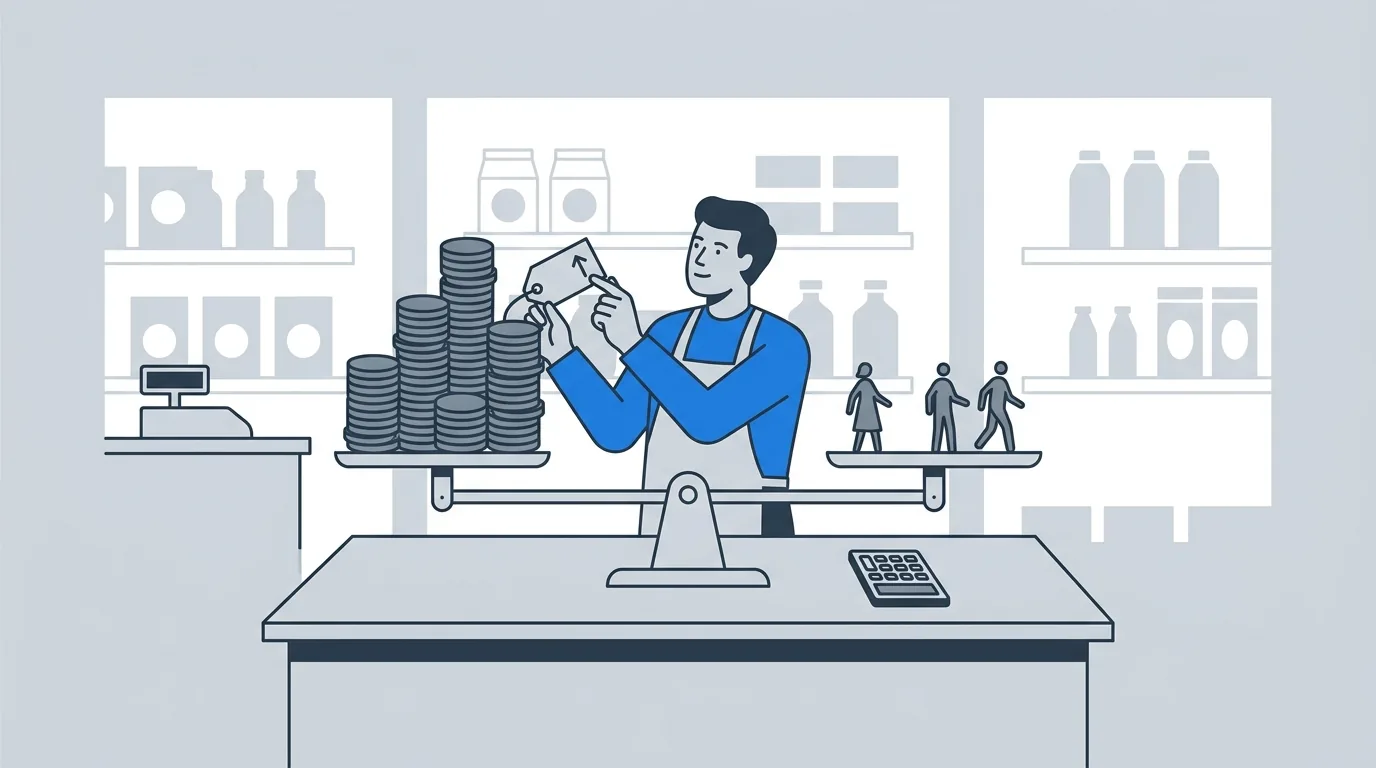
You raise prices without losing customers by treating the increase as arithmetic first and a conversation second. Before you tell anyone anything, work out how many customers you could lose and still earn the same profit as today. Often that number is larger than the fear suggests: at a 40% contribution margin, a 10% increase leaves you exactly as well off even if one customer in five walks. Once you know your number, the rollout is mechanical. Tell your best customers first and in person, give at least one full billing cycle of notice, send a short message that states the new price, the date and one honest reason, and then watch three numbers for eight weeks. You will probably lose a few. The point is knowing in advance how many would actually hurt.
The polite email is the easy part. What keeps owners sitting on an overdue increase is not knowing what happens to the business if that email goes badly. Fix that first and the email gets much easier to send.
How many customers can you afford to lose?
The formula answers one question: after the increase, how much volume can disappear before total profit falls below today's?
Allowable volume loss = price increase % ÷ (contribution margin % + price increase %)
Two terms need pinning down.
Price increase % is the size of the rise, as a percentage of the current price. Going from $100 to $110 is 10%.
Contribution margin % is the share of each sale left after the costs that go away when that sale goes away. For a service business that usually means materials, supplies, fuel and mileage for the visit, subcontractors on that job, and the card fee on the payment. It does not include rent, insurance, software or your phone, because those stay whether you lose a customer or not. If you want the formal definition, this explanation of contribution margin covers it, including the ratio version we are using here.
One caution for owner-operators: your own time does not disappear when a customer leaves, at least not in the short run, so leave your labour out of the variable costs. That makes your contribution margin high, and as you will see, a high margin means less room to lose customers, not more.
A worked example
These are round numbers I made up to show the arithmetic. They are an example, not a benchmark and not anyone's real business.
A house cleaning business has 100 regular customers. Each one pays about $1,000 a year. The costs that disappear if a customer leaves (supplies, fuel, a share of subcontracted cover, card fees) come to $600 a year per customer. So each customer contributes $400, a 40% contribution margin, and the whole book contributes $40,000 a year toward overhead and the owner.
The owner raises prices 10%, so each customer now pays $1,100. The variable costs do not change, so each customer now contributes $500.
| Step | Arithmetic | Result |
|---|---|---|
| Contribution today | 100 customers × $400 | $40,000 |
| Contribution per customer after the rise | $1,100 - $600 | $500 |
| Customers needed to match today | $40,000 ÷ $500 | 80 |
| Customers you can lose | 100 - 80 | 20, or 20% |
| Formula check | 10 ÷ (40 + 10) | 20% |
The long way and the formula agree: this business can lose 20 of its 100 customers and earn the same contribution it earns now. Lose fewer than 20 and it is ahead.
Notice what happens to revenue at the break-even point. Eighty customers at $1,100 is $88,000, down from $100,000. Revenue falls by $12,000 and contribution stays exactly the same. The twenty customers who left took $20,000 of revenue and $12,000 of variable costs with them, and the eighty who stayed pay $8,000 more between them. Minus $20,000, plus $12,000, plus $8,000: zero. If you look only at the top line after a price rise, you can talk yourself into thinking it failed when it worked.
How the number moves with your margin
| Contribution margin | 5% increase | 10% increase | 15% increase |
|---|---|---|---|
| 30% | 14.3% | 25.0% | 33.3% |
| 40% | 11.1% | 20.0% | 27.3% |
| 50% | 9.1% | 16.7% | 23.1% |
| 70% | 6.7% | 12.5% | 17.6% |
Each cell is the share of customers (or volume) you could lose and still match today's profit. Bigger increases buy more room. Higher-margin businesses have less, because each lost customer takes more profit with them. A solo consultant or groomer running at a 70% contribution margin who raises prices 10% breaks even at a 12.5% loss, not 20%.
Three caveats keep this honest. The formula assumes the customers who leave are average ones; if your biggest accounts are the likeliest to go, your real room is smaller. It ignores the time you get back, which you could refill with new work at the new price. And it is a ceiling, not a forecast. It tells you where the line is, not how many will actually cross it.
When is the right moment to change prices?
The best signals come from your own book, not the calendar. You are booked out further than you would like. You are winning nearly every quote you send. Your costs have gone up and your prices have not. It has been more than a year since you last looked. Any two of those together is a strong case.
You are also not alone in the cost squeeze. In the Federal Reserve's 2024 Small Business Credit Survey of employer firms, 75% of firms cited rising costs of goods, services or wages as a financial challenge, the most common one in the survey. Your customers are paying those same higher prices everywhere else, which makes "my costs went up" one of the easiest reasons to state plainly.
Avoid timing it to your own anxiety. The week after a complaint or a slow month is when you over-explain and under-raise. Tie the date to something neutral, like the start of a quarter or a new season.
If your pricing structure itself is the problem (hourly work that keeps getting faster, fixed quotes that keep growing), a rate change will not fix it. Sort the structure out first with how to price your services, then raise the number.
Who should hear first?
Not everyone at once, and not by mass email first.
- Your best customers. The top ten or twenty by revenue or by how long they have been with you. They hear it in person, on the phone or in a personal message, before anyone else.
- Regulars on a recurring schedule. A personal note, ideally at their next visit, followed by the written notice.
- Occasional and one-off customers. The written notice is enough.
- New customers. They simply see the new price from the effective date. No announcement needed.
The order matters. Your best customers would eat through your allowable loss fastest, and talking to them first tells you early whether your reason and your number land. If three loyal customers in a row wince, you still have time to adjust before the letter goes out.
How much notice is enough?
Start with your contracts and any written quotes. If a customer agreement specifies a notice period, that period wins, and it is worth reading before you pick a date.
Beyond that, a practical floor is one full billing or service cycle. A weekly customer should get at least a few visits of warning. A monthly retainer client should see the notice before the invoice that is about to change is issued. Annual contracts change at renewal, and the notice should arrive well before the renewal conversation.
Extra notice costs you little, a few weeks at the old price. Less than a cycle feels like an ambush, even when the increase is modest.
What should the message actually say?
Short beats thorough. The structure that works has five parts:
- The change, in the first sentence. "From March 1, a standard clean will be $110, up from $100."
- The date it takes effect. Already in that sentence, which is the point.
- One honest reason. "Supplies, fuel and insurance have all gone up, and this is our first change in two years." One reason, stated plainly. A list of five sounds defensive.
- What stays the same. Same team, same schedule, same standard.
- A way to talk. "If you'd like to talk about it, reply here or ask me at your next visit."
Leave out apologies and the long history of the business. Do not ask permission, and do not offer a discount in the same breath, because that teaches every customer to push. If you choose to protect a small group, do it by name in a separate conversation.
What do you measure in the two months after?
Eight weeks is long enough for recurring customers to hit at least one bill at the new price and short enough that you can still tell what caused what. Track three things, weekly.
- Customers lost, against your allowable number. Count cancellations and customers who have gone quiet, and compare the running total to the ceiling you calculated. That comparison is the whole reason you did the arithmetic. The habit of counting who is still with you is covered in more depth in customer retention rate for a small business.
- Contribution, not revenue. Money in, minus the variable costs, compared with the same weeks before the change. This is the number that tells you whether the rise worked.
- New-customer conversion at the new price. Are quotes and first bookings closing at roughly the same rate as before? If not, the market is telling you something about the new number that your loyal customers were too polite to say.
The rollout checklist
- Pull twelve months of entries and your customer list
- Work out your contribution margin (revenue minus costs that leave with a customer, divided by revenue)
- Pick the increase and calculate your allowable loss
- Check contracts and quotes for notice terms
- Pick a neutral effective date at least one full cycle away
- Talk to your top customers personally
- Tell recurring regulars at their next visit
- Send the written notice (change, date, one reason, what stays, how to talk)
- Update prices everywhere on the effective date: quotes, website, invoices
- Track losses, contribution and new-customer conversion weekly for eight weeks
Run your number before you send anything
Your break-even loss number is already sitting in your records: the customer list tells you how many you have and the money entries tell you what each one costs you to serve. Open your customer list in SMBDashboard and count your active book, then use the money module to total the last twelve months of sales and the costs that go with them. The free tier holds 25 customers and 200 money entries, which covers a full year for plenty of small operations. It takes a few minutes, it runs in your browser, and your data stays in your browser unless you turn on Pro sync.
If you want to see what your margin is actually made of before you run the formula, profit margin for a service business walks through which costs belong where. For a trade-specific take, see dog grooming business pricing.
A boundary worth stating: this is the mechanics of a pricing decision, not advice on what you should charge. Anything that touches tax treatment or contracts belongs with your bookkeeper, accountant or a lawyer, and the IRS Tax Guide for Small Business (Publication 334) is the primary source for how business income and costs are treated.
Frequently asked questions
How much can I raise prices at once?
As much as your allowable loss can absorb and your market will bear. Run the formula for a few sizes. A larger single increase gives you more room to lose customers than a small one, and it is one awkward conversation instead of several. What it cannot do is tell you how customers will react, which is why the first conversations with your best customers are worth having before the letter goes out.
Should I grandfather existing customers?
Sometimes, briefly. Keeping loyal customers on the old price for a set period, such as three or six months, softens the change without creating a permanent two-tier book. Indefinite grandfathering means your oldest customers slowly become your least profitable ones. If you do it, put an end date on it in writing.
How do I tell regulars about a price increase?
In person or by a personal message first, then in writing. Say the new price and the date in the first sentence, give one honest reason, and say what is not changing. Then stop talking and let them respond. Regulars mostly want to know that the service they rely on is staying the same.
What if customers push back?
Listen, restate the reason once, and hold the price. If someone genuinely cannot afford it, offer a smaller or less frequent version of the service rather than a discount on the same service. Then add them to your count. If pushback stays inside your allowable loss, the increase is working, even when it does not feel like it.