 SMBDashboard
How to Track Where Your Customers Come From
By Mark Fulton · 2026-09-15 · 12 min read
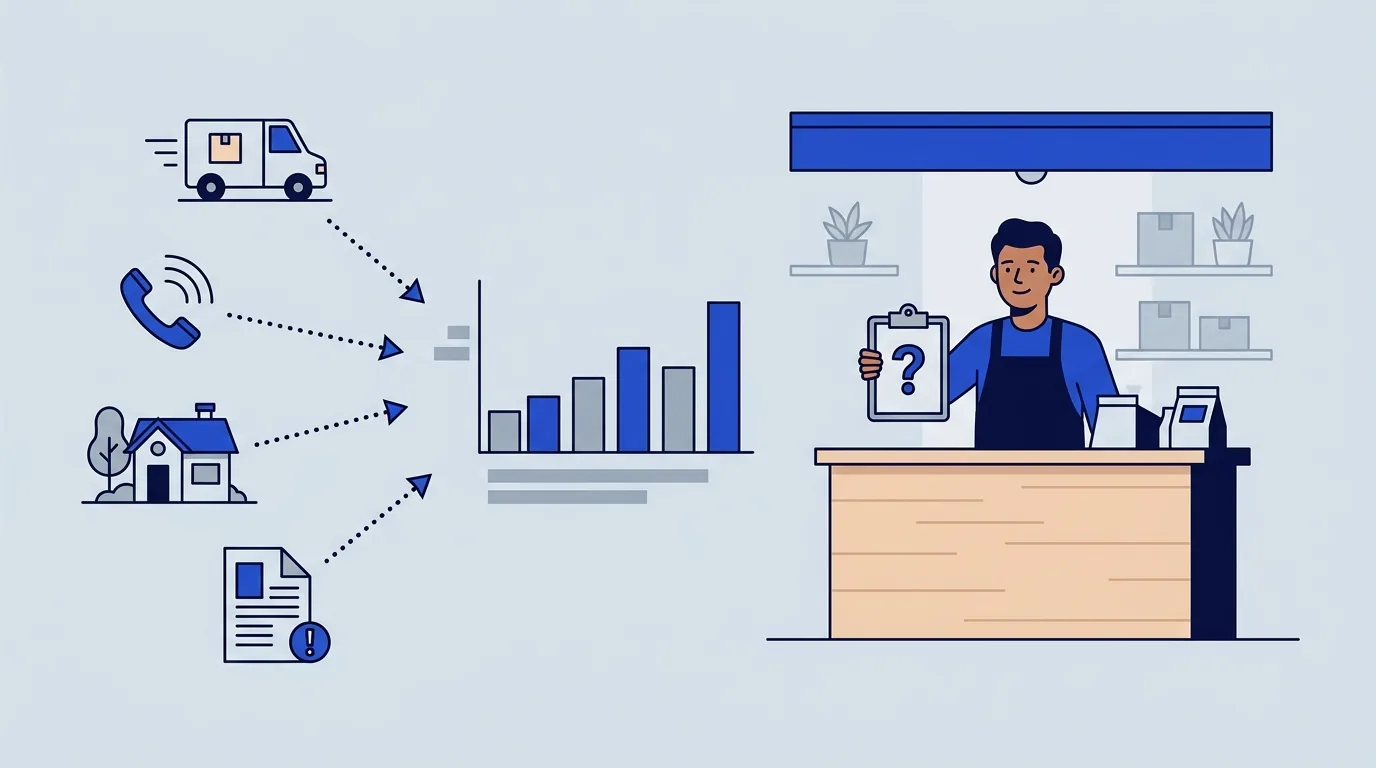
To track where your customers come from, ask every new customer one question at the moment they book: "How did you first hear about us?" Write the answer on their customer record straight away, as a short tag from a fixed list of six or seven sources, before the call ends. Once a month, count the tags, set the count beside what each channel cost you, and move a small amount of next month's spend toward what's pulling. For a business whose customers arrive by phone, a sign on the van, a neighbour's recommendation or a map listing, that one field does more than analytics software can, because most of those journeys never touch a website. It measures what customers remember rather than what actually happened, and for a decision about next month's budget, that's enough.
Why does attribution software struggle with local businesses?
Attribution software follows clicks. It sees someone land on your website from an ad, a search result or a tagged link, and it records the path. That works when the customer's journey happens inside a browser.
A local service business rarely gets customers that way. Think about how a plumber actually gets a job. Someone's neighbour mentions him over the fence. Two weeks later the pipe bursts, they remember the name, search for it, tap the phone number on the map listing and call. The software, if it sees anything, sees a branded search. The neighbour, the real reason for the call, is invisible.
The same thing happens with van signage, a flyer on a café noticeboard, a sponsored kids' football shirt, a Facebook group recommendation someone read on their phone and then acted on from their laptop. None of it leaves a trail you can install a tag on. The SBA says as much in its guide to managing your marketing: some tactics, like print advertising or word of mouth, are hard to measure, so be consistent in how you measure.
That's the useful instruction hiding in there. You can't measure these channels perfectly. You can measure them the same way every time, and a consistent imperfect measure is what lets you compare one month to the next.
There's a second problem with software for a small operator: the setup and the reading of it. Tagged links, call tracking and conversion events are real tools, and a business spending serious money on paid search should use them. But if your marketing is a van, a map listing and a referral habit, you'd be building a measurement system bigger than the thing it measures.
When should you ask the question?
At the moment of booking. Not after the job, not in a follow-up email, not on a feedback form.
Booking is the one point where three things are true at once. The customer is already talking to you, so the question costs them nothing. The memory of how they found you is as fresh as it will ever be. And you're about to create a record for them anyway, so there's somewhere to write the answer.
Every later moment is worse. After the job, the memory has been overwritten by the job itself: they remember that you fixed the boiler, not the flyer. A follow-up email gets ignored by most people and answered by an unrepresentative few. A form at the end of a visit gets filled in by whoever has a spare minute, which is not a sample of anything.
In practice that means the question lives wherever bookings happen:
- On the phone: as part of taking their name and address. "And how did you first hear about us?" slots in naturally right after the address.
- On a booking or enquiry form: a required dropdown, placed near the end, with the same options you use on the phone.
- In person: at the counter, as you write the ticket or take the deposit.
- By text or message: one line in your reply that confirms the booking.
If more than one person takes bookings, this is where the system usually breaks. The fix is not a training session. It's making the source field part of the booking itself, so a booking without one looks unfinished.
How do you get an honest answer?
Wording matters more than people expect. "How did you hear about us?" is ambiguous in a way that quietly spoils the data. It could mean the first time they ever heard your name, or the thing that finally made them pick up the phone today. Those are often different, and the customer will pick whichever one they happen to think of.
So pick one on purpose. For a local business, I'd ask about the first time, because that's the channel you're paying to build: "How did you first hear about us?" If the answer is "I searched online," follow with one gentle second question: "Had you come across us before that, or was that the first time?" A lot of "Google" answers turn into "my sister used you last year" at that point. The search was how they found your number. The sister was how they found you.
Four more habits keep the answers clean:
- Ask it open, record it closed. Let the customer answer in their own words, then you choose the tag. Reading a list of options aloud invites people to pick the first plausible one.
- Keep the list short and fixed. Six or seven sources that match how your business actually gets work, plus "not sure". Something like: referral, map listing, search, van or sign, social media, repeat, not sure. Don't invent a new tag on the fly for every answer.
- Capture names on referrals. "Referral" on its own is the least useful tag you have. "Referral: Dana on Elm Street" tells you who to thank, and over a year it shows you which three or four customers are quietly sending you work.
- Don't lead the witness. "Did you see our van?" gets a yes from people being polite. Ask the open question and let silence do the work.
What do you do with "I can't remember"?
Record it as exactly that. The worst thing you can do with an honest "not sure" is guess.
When the owner fills in the blank with their best hunch, the hunch almost always lands on whatever channel they were already proud of or already worried about. That turns a gap in the data into a confirmation of what you believed before you started collecting it, which defeats the point.
"Not sure" is data in its own right. Three things to do with it:
- Watch its share. If it's a small slice of your monthly count, ignore it and read the rest. If it climbs to be one of your biggest tags, your question is the problem, not your customers. Try the "first hear about us" wording, or add the follow-up question.
- Try one prompt, not a list. "Did someone mention us, or did you find us yourself?" splits the pile into word of mouth and self-found without putting a specific answer in their mouth.
- Leave it out of the channel comparison. When you compare channels, compare the answers you have. Don't spread the unknowns across channels in proportion, because that assumes the people who forgot found you the same way as the people who remembered, and there's no reason to believe it.
Which free methods add real signal?
The question is the backbone, but a few other methods can back it up for specific channels. Each costs little or nothing, and each one lies to you in its own way. That last column is the one worth reading.
| Method | Effort to set up and keep | What it can prove | Where it lies to you |
|---|---|---|---|
| The asked question | Low. One question at booking and one tag per customer | Where customers believe they found you, across every channel including offline ones | Memory. People credit the last thing they touched (usually search) and forget the first (usually a person) |
| A distinct phone number | Medium. A spare line used only on one channel, such as the van or a flyer | That someone dialled the number printed on that one channel | People save your number, look you up again later or call your main line, so the channel gets less credit than it earned |
| A dedicated landing page | Medium. A page on your site that only appears in one place, like a printed flyer | That someone typed or scanned that exact address | Visits are not customers, and anyone who searches your name instead of typing the address disappears |
| A mention code | Low. "Mention the flyer when you book," with or without an offer attached | That the customer had the flyer in hand, or remembered it clearly, when they booked | People who didn't keep the flyer don't mention it, and if a discount is attached, existing customers go looking for it |
| A manual tally of enquiries | Low but relentless. A tick sheet by the phone for every enquiry, booked or not | Which channels bring enquiries, including the ones that never became customers | It's the first habit to lapse on a busy week, and a tally with gaps looks just as confident as a complete one |
Two notes on that table. First, if you have a Google Business Profile, you already have a partial version of the phone and website rows for free: its performance report counts clicks on your call button, direction requests and website clicks from your listing. Use it as a cross-check on your "map listing" tag. It counts taps, not bookings, so it will always run higher.
Second, if you do put a link on a flyer or in an email, tag it. Google's help page on building campaign URLs shows how to add source and medium to a link so your website analytics can separate one campaign from another. That covers the website side of one channel. It doesn't replace the question, which covers everyone.
The pattern across all five methods: every one of them measures one piece of the journey well and the rest badly. The asked question is the only one that reaches every channel at once. So ask it, and use the others to double-check the channels you're spending the most on.
How do you turn the answers into a spending decision?
Once a month, do four things. It takes about as long as making a coffee.
- Count new customers by source tag. Only new customers who booked that month. Repeat customers go in their own pile, because retention is a different question (and measuring it for a local business works differently too).
- Add what each source cost. Money actually spent that month: the flyer print run, the ad budget, the directory fee. Referrals and your map listing may cost nothing in cash.
- Add what those new customers paid. First-job revenue is enough to start with.
- Change one thing. Move a small, reversible amount of money or time toward the strongest channel, or pause the weakest. One change a month, so next month tells you whether it helped.
Here's a worked example, with illustrative figures rather than real ones. A mobile detailer tags a month of new customers: 9 referrals, 6 map listing, 4 from the van, 3 from a paid local directory listing, 2 not sure. The directory cost money that month and brought three customers. The referrals cost nothing and brought nine. The obvious move isn't to cancel the directory on one month of data. It's to put a small effort into referrals, such as thanking the named referrers, and keep watching the directory for two more months before deciding.
That's the honest limit of this method. It tells you where customers think they came from, and it only hears from people who became customers. It can't see the people who saw your ad and chose someone else. For a local business choosing between five or six channels, that's still the difference between deciding on evidence and deciding on a feeling.
To be clear about where this stops: this is a way to organise your own information, not financial or marketing advice. How much to spend, and whether a channel pays for itself after tax and overheads, is a conversation for your accountant or bookkeeper.
If you want this to run without a separate spreadsheet, put the source on the customer record itself. In SMBDashboard, the customer list has free-form tags on every record. Add a tag like src:referral or src:van when you create the customer and the Tags column becomes your channel report. The Ctrl+K search finds customers by tag, and Pro's CSV export includes the tags if you'd rather count them in a spreadsheet. The free tier holds 25 customers, there's no account to create, and your data stays in your browser unless you turn on Pro sync. If a whole CRM feels like more than you need, a simple CRM is enough for most small businesses makes the case for keeping it this small, and if enquiries are slipping before they ever become customers, start with tracking leads without a CRM.
Frequently asked questions
How do I know which advertising is working?
Ask every new customer how they first heard about you, record the answer as a tag on their record, and count the tags monthly next to what each channel cost. For any channel you spend real money on, back the question up with something channel-specific: a distinct phone number, a dedicated page, or a tagged link. When two methods agree, trust the result. When they disagree, the question is usually undercounting the first touch and the channel method is undercounting people who came back later.
Where should I record how a customer found me?
On the customer record, at the moment you create it. A separate "marketing" spreadsheet is a second place to update, and a second place is the one that gets skipped. Kept on the record, the source travels with the customer, so you can later see which sources bring customers who come back, not just customers who book once.
Is "how did you hear about us" reliable?
It's reliable enough to make monthly decisions with, as long as you know how it fails. People remember the last step better than the first, so search and map listings tend to get too much credit and word of mouth too little. It also only hears from people who became customers. Ask about the first time they heard of you, never guess on their behalf, and treat the answers as direction rather than proof.
How long before I can judge a marketing channel?
Longer than a month for most channels. A single month of new customers is a small number, and one busy week or one enthusiastic referrer can swing it. Give a channel two or three months of consistent tagging before cutting it, and let print or signage run longer, because people often hold onto a flyer or remember a van for weeks before they need you.